Lecture 06. Monty Hall, Simpson's Paradox (Statistics 110, Harvard)
이 포스팅은 Harvard에서 진행된 Joe Blitzstein의 Statics 110 강좌를 기반으로 작성되었습니다.
Monty Hall (Three Doors) Problem
1 door has a car (which you desire), 2 doors have goats (which you don’t), Monty knows which.
You pick one, Monty always opens a goat door. (If he has choice, he picks with equal prob.)
Should you switch your first choice?
Note: if Monty oopens Door 2, we know Door 2 has a goat, and Monty opened Door 2.
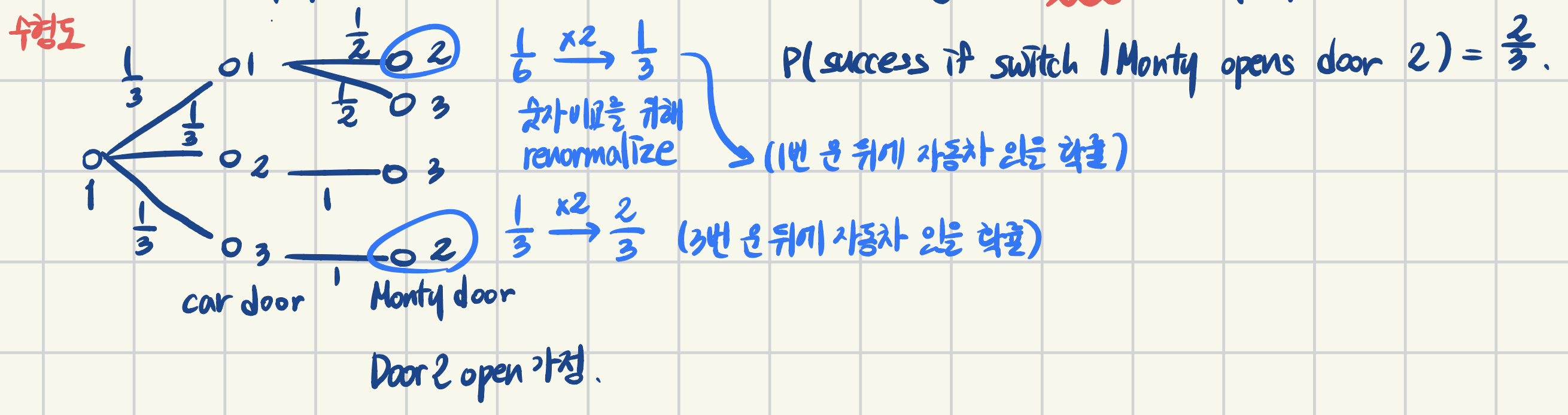
[Solution 1: Tree]
Suppose we always choose Door 1.
[Solution 2: LoTP (Law of Total Probability)]
LoTP could be rewritten as “wish we new where the car is”
- $S$: succeed when switch
- $D_j$: j-th door has a car ($1 \leqslant j \leqslant 3$)
By symmetry, $P(S \vert \text{Monty opens 2}) = \frac{2}{3}$
Simpson’s Paradox
1

부분 확률의 대소 관계는 전확률 관점에서 뒤집힐 수 있다.
아래와 같이, Hibbert와 Nick의 각 수술에 대한 확률이 다음과 같다고 하자.
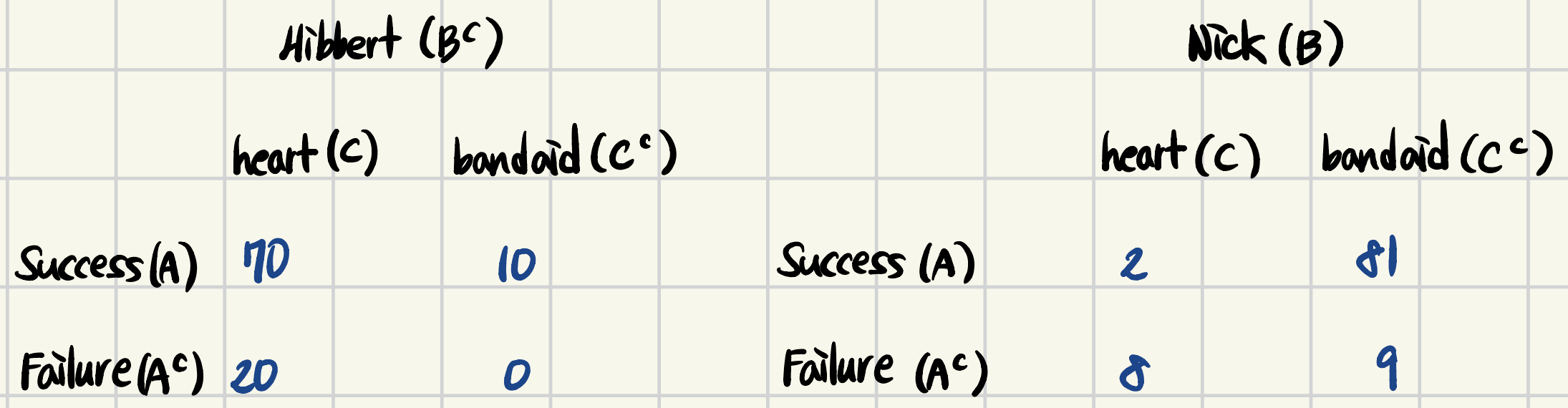
모든 수술을 종합하여 봤을 때의 성공률 (전확률): 80% (success $\vert$ Hibbert) < 83% (success $\vert$ Nick)
심장 수술을 한다는 조건: $\frac{70}{90}$ (success $\vert$ Hibbert, heart surgery) > $\frac{2}{10}$ (success $\vert$ Nick, heart surgery)
[Simpson’s Paradox의 기본적인 형태]
- $A$: successful surgery
- $B$: treated by Dr. Nick
- $C$: having heart surgery (confounder, 교란자)
[LoTP로 Simpson’s Paradox가 틀렸음을 증명할 수 없음]
$P(A|B) = P(A|B,C)P(C|B) + P(A|B,C^C)P(C^C|B)$ 에서,
$P(A|B,C) \lt P(A|B^C,C)$, $P(A|B,C^C) \lt P(A|B^C,C^C)$는 위 테이블을 통해 알 수 있지만,
$P(C|B), P(C^C|B)$가 총합이 1인 서로 다른 값의 가중치로 작용하기 때문에 Simpson’s Paradox가 발생 가능하다.
추가 설명
$P(C|B), P(C^C|B)$는 각각 Nick이 heart surgery를 할 확률과 bandaid removal을 할 확률을 말한다.
여기서, 전확률의 관점에서 “Nick의 총 수술 횟수”를 알 수 없기 때문에 부분 확률과의 대소 관계가 달라질 수 있다.